Why Dirty Data Is Costing Your Business More Than You Think
The hidden financial cost of bad data — and a practical framework for cleaning and validating your business data.
A business owner in Jharkhand lost ₹3.2 lakh in just 3 months…
Not because sales were low.
Not because customers stopped coming.
But because of one small mistake in his Excel data.
And the scary part?
He didn’t even realize it was happening.
At first glance, everything looked normal.
- Sales were happening
- Inventory was moving
- Reports were being generated
But underneath…
His entire business was running on wrong numbers. And this is where most businesses are today.
THE REAL PROBLEM
Let’s break it down simply.
Dirty data = wrong, incomplete, or inconsistent data.
It’s the silent killer of business profitability and scalable operations.
It usually looks like:
- Duplicate entries: Same customer or product repeated
- Missing values: Price, quantity, or date missing
- Wrong formats: Numbers stored as text, date confusion
- Manual errors: Wrong typing, incorrect entries
Sounds familiar?
If you’re using Excel sheets, billing software, stock registers, or CRM tools — then chances are, your business already has dirty data.
And the worst part? You don’t even know how much it’s costing you.
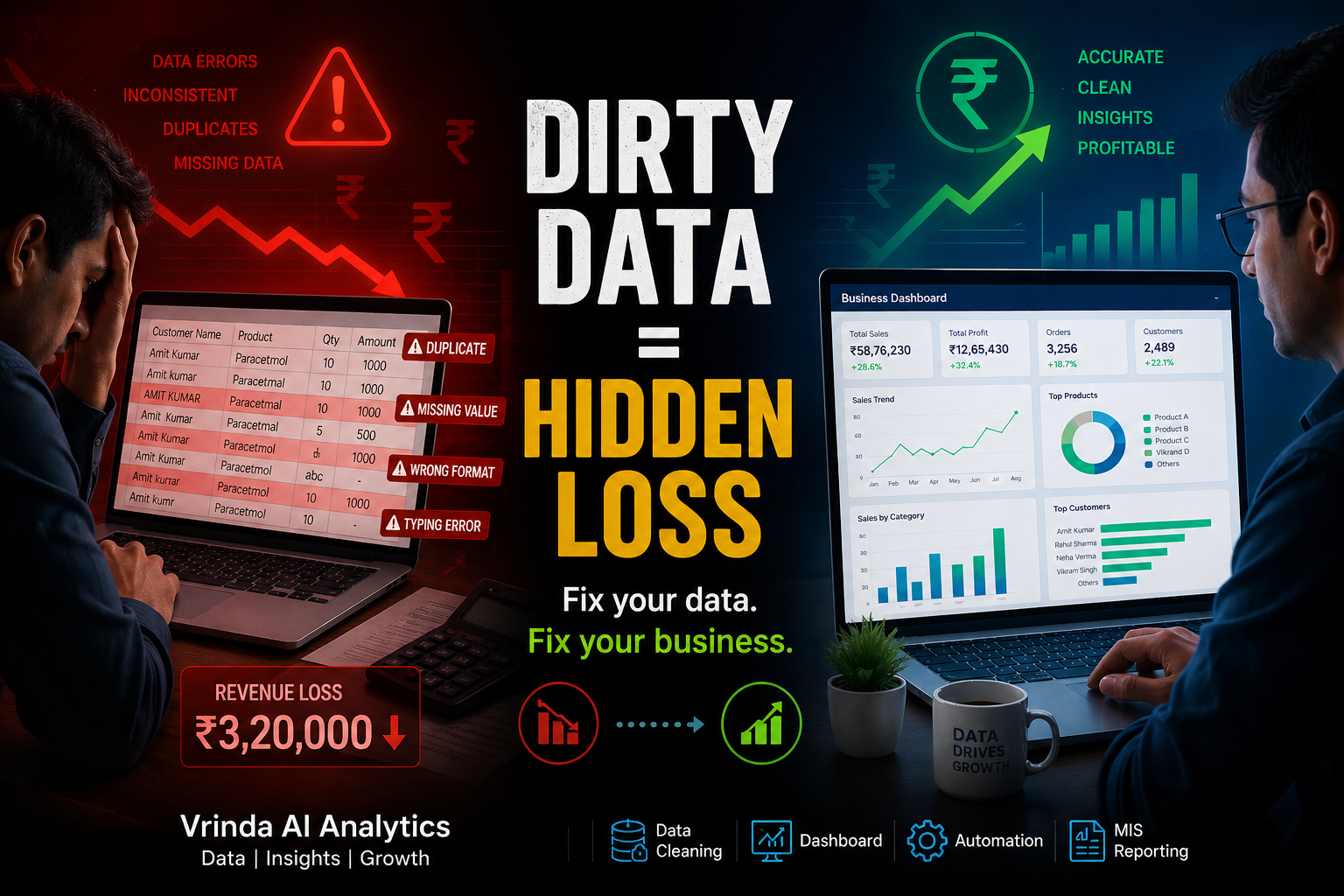
❌ Raw Data: Messy, inconsistent, and impossible to trust
HIDDEN COSTS (THIS IS WHERE MONEY BLEEDS)
Dirty data doesn’t just “look messy”… It directly impacts your revenue.
1. Wrong Business Decisions
If your data shows a product is performing well (but it’s not)… You’ll invest more in it.
Result: Dead stock + blocked capital
2. Stock Mismanagement
Duplicate entries = incorrect inventory count.
Result: Lost sales and Customer dissatisfaction.
3. Revenue Leakage
Small errors = big losses.
4. Wasted Marketing Budget
Wrong customer data = wrong targeting.
Result: ₹10K–₹50K wasted every month.
Dirty data doesn’t scream… it silently drains your business.
REAL-LIFE STYLE EXAMPLE (CASE STUDY)
Let’s see how this actually looks in a real business.
BEFORE (Messy System)
Multiple Excel files. Duplicate customer records. No clear sales tracking. The business felt “okay”… but there was absolutely no clarity on real profitability.

What looks like normal data… is silently draining your profits.
AFTER (Structured Data System)
We implemented Data cleaning, Standardized formats, and Automated reporting to replace the manual chaos.

📊 Dashboard: Clear insights, faster and smarter decisions
📈 RESULT
- Identified ₹1.8 lakh revenue leakage
- Improved stock accuracy by 35%
- Increased decision-making speed by 2X
Same business. Same customers. Only change = Clean data system.
WHY BUSINESSES IGNORE THIS
Let’s be real. Most business owners think:
“Excel hai, kaam ho raha hai…”
“Abhi system banane ka time nahi hai…”
But here’s the truth:
Manual systems are slow, error-prone, and not scalable.
SOLUTION
Fixing data is not a one-time task. It’s about building a system.
- Data Cleaning: Fix errors, remove duplicates, structure properly
- Automation: Reduce manual work → reduce mistakes
- Dashboards: Visual clarity → better decisions
- MIS Reporting: Track performance in real-time
When your data becomes clean… Your business becomes predictable, scalable, and profitable.
Most businesses think they have a sales problem or a marketing problem. But in reality… They have a data problem. And until that is fixed, nothing else will truly work.
Not sure if your data is correct?
Your data can either confuse you… or grow your business. Let’s find out. Get a FREE Data Audit, identify hidden losses, and build a system that scales.
About VRINDA AI ANALYTICS
At Vrinda AI Analytics, we help businesses transform chaos into clarity.
We specialize in:
- Data cleaning & structuring
- Power BI dashboards
- MIS reporting systems
- Excel automation
We don’t just create reports — we build systems that drive decisions.
📞 +91 6204829055 · 📧 info@vrindaai.com · 🌐 vrindaai.com
FREQUENTLY ASKED QUESTIONS
How do I know if my business has a dirty data problem?
The clearest signs are duplicate customer or product entries, numbers stored as text, mismatched date formats between sheets, and different departments quoting different figures for the same metric. If two people pull a report on the same day and get different totals, that is dirty data, not a reporting bug.
Can dirty data really cost a small business money, or is that exaggerated?
It is not exaggerated. Wrong stock counts lead to over-ordering or stockouts, duplicate customer records skew sales targets, and bad date formats silently break month-over-month comparisons. The business owner in this article lost Rs 3.2 lakh in three months from one uncorrected Excel mistake, and that pattern is common, not rare.
How long does it take to clean a business's existing data?
For a single dataset — one product list, one customer register — a proper clean typically takes a few days once the source files are gathered. Cleaning everything a mid-sized business runs on, across sales, inventory and accounts, usually takes two to four weeks and is the majority of the effort in any new MIS or dashboard project.
Is data cleaning a one-time job or an ongoing need?
Both. An initial clean fixes the backlog of existing errors, but new dirty data enters every day through manual typing, duplicate entries and inconsistent formats. The lasting fix is validation rules built into the data pipeline so errors are caught automatically, not a one-time cleanup that slowly degrades again.
What tools are used to clean business data?
For most small and mid-sized businesses, Power Query inside Excel handles the bulk of the work: deduplication, standardising formats, and flagging incomplete rows, without writing code. For larger or multi-source datasets we use Python and SQL to build repeatable, automated cleaning pipelines rather than one-off fixes.